
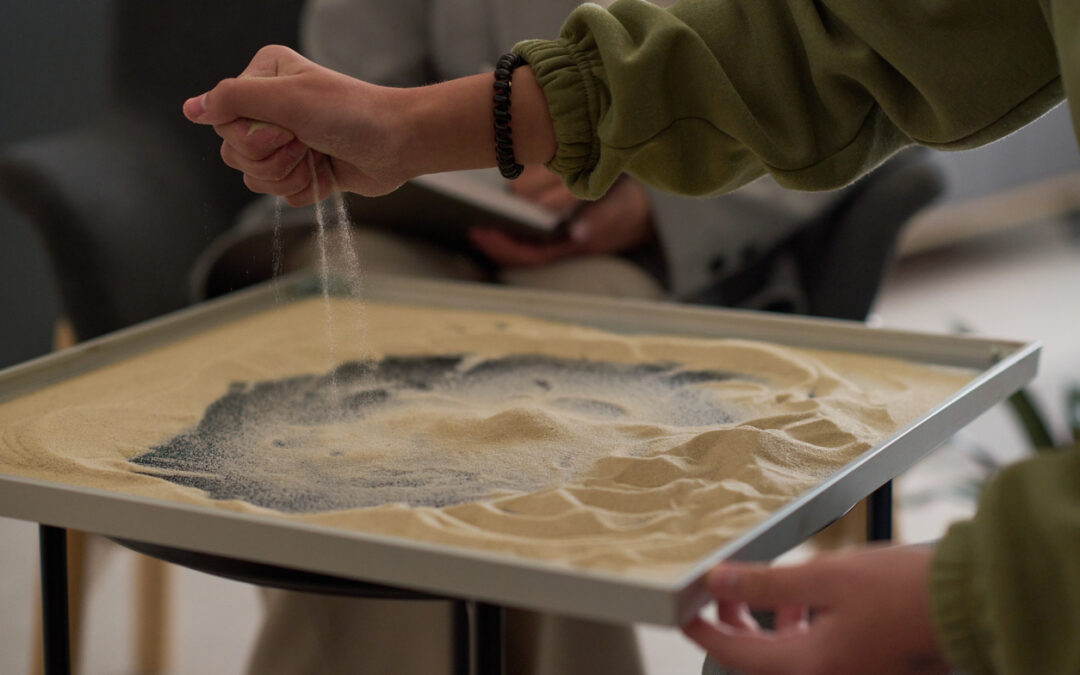
Sand Tray Therapy is an expressive modality that gives clients a safe, creative way to process trauma, explore emotions and build self-awareness. This course offers mental health professionals a thorough introduction to it, centered on trauma work and emotional processing.
Participants study the theory behind Sand Tray Therapy, see how symbolic expression supports healing and get hands-on practice with miniatures and tray techniques. The course also covers neuroscience-informed principles that explain why the approach works with children, adolescents and adults. Case studies, experiential learning and guided demonstrations leave attendees with practical skills to add Sand Tray Therapy to clinical work.
Upon completion of this training, participants will be able to
- Understand the theoretical foundations of Sand Tray Therapy and its connection to trauma processing.
- Identify the role of symbolic representation in emotional expression and healing.
- Utilize Sand Tray techniques to support clients in exploring and resolving trauma.
- Recognize key themes and patterns that emerge in Sand Tray work and apply appropriate clinical interventions.
Syllabus:
Introduction
Objective #1: Understand the Theoretical Foundations of Sand Tray Therapy
- Identify the Jungian and symbolic underpinnings of Sand Tray Therapy
- Explain how expressive therapy frameworks support nonverbal access to trauma material
- Describe key neuroscience principles that inform Sand Tray Therapy’s effectiveness
Objective #2: Understand Trauma Processing and Symbolism in Sand Tray
- Recognize symbolic patterns that reflect trauma responses in the tray
- Differentiate between trauma-linked symbolism and indicators of healing
- Analyze how symbolic evolution reflects trauma integration
Objective #3: Apply Techniques of Sand Tray Therapy
- Demonstrate knowledge of the therapist stance, including reflective presence and containment
- Design a sand tray setup that promotes safety and inclusivity
- Apply principles of client autonomy in facilitating sand tray sessions
Objective #4: Integrate Sand Tray into Trauma Practice
- Utilize both directive and non-directive prompts into clinical practice
- Adapt sand tray intervention for telehealth and remote delivery
- Apply sand tray interventions to diverse trauma case scenarios across the lifespan
Summary/Q&A
Social workers completing this course receive 3 Clinical asynchronous continuing education credits.
For other board approvals, this course qualifies for 3 Clinical continuing education training.
Instructor: Samantha Silverberg-Stout, M.A., L.P.C.
Recording Date: October 11, 2025
CEUS On-Demand, LLC, provider #2274, is approved as an ACE provider to offer social work continuing education by the Association of Social Work Boards (ASWB) Approved Continuing Education (ACE) program. Regulatory boards are the final authority on courses accepted for continuing education credit. ACE provider approval period: 08/7/2026 - 08/6/2027. Social workers completing this course receive 3hrs Clinical continuing education credits.
CEUs On-Demand, LLC has been approved by NBCC as an Approved Continuing Education Provider, ACEP No. 7091. Programs that do not qualify for NBCC credit are clearly identified. CEUs On-Demand, LLC is solely responsible for all aspects of the programs.
System Requirements: Firefox, Chrome, Brave, Safari, Edge on any modern operating system (Windows, MacOS, Linux, Android, iOS). A desktop browser is recommended. We do not provide support resources for issues encountered using a mobile device.
Request for Special Accommodations: Learners can request special accommodations by contacting the administrative team at admin@ceus-ondemand.com